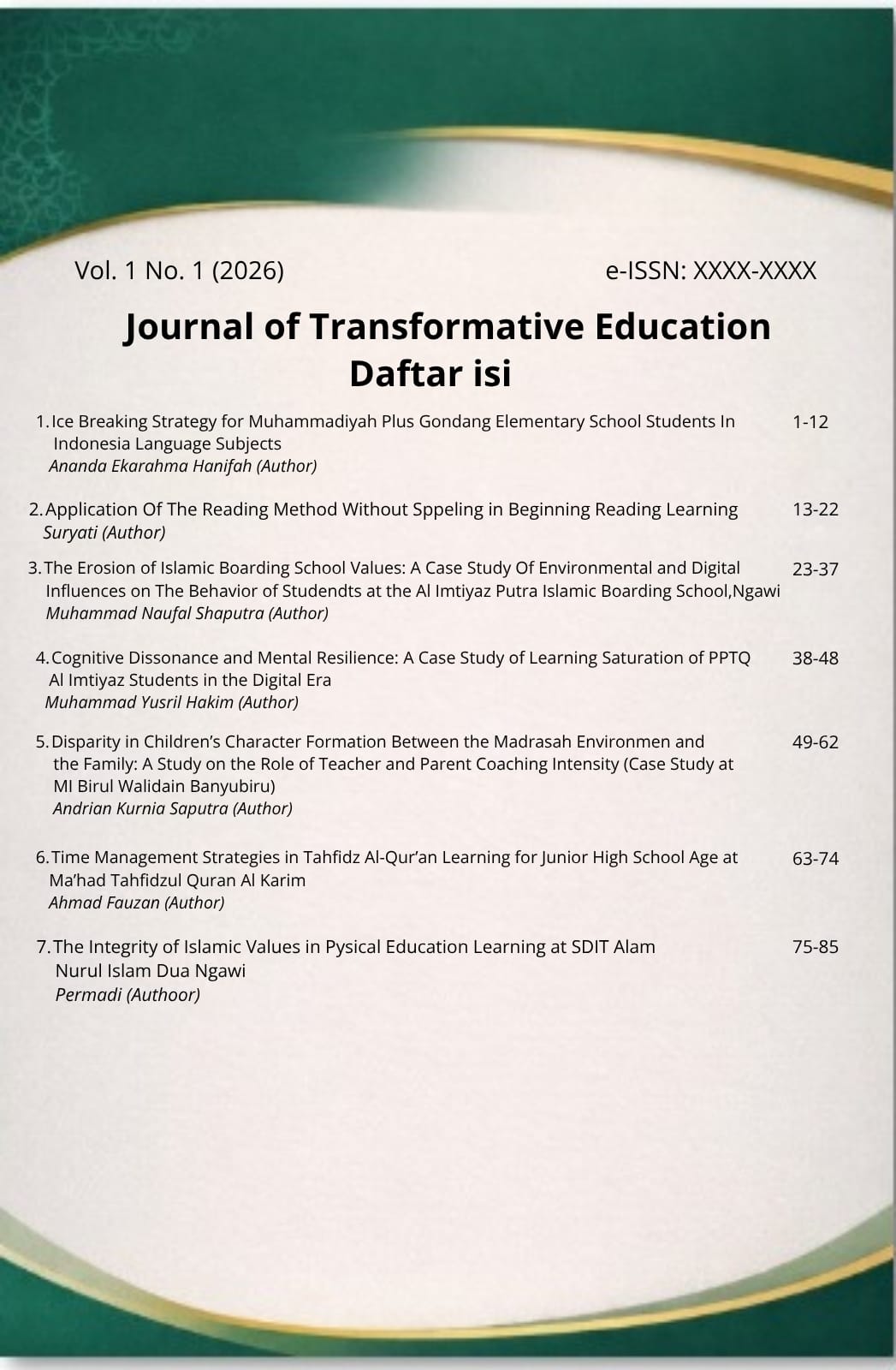
Time Management Strategies in Tahfidz Al-Qur'an Learning for Junior High School Age at Ma'had Tahfidzul Quran Al Karim
DOI:
https://doi.org/10.66277/catalyst.1.1.14Keywords:
time management, Qur'anic memorization, junior high school students, Islamic educationAbstract
This study examines time management strategies in Qur'anic memorization (tahfidz) learning among junior high school-aged students at Ma'had Tahfizhul Quran Al Karim. The research is grounded in the complexity faced by adolescent students in simultaneously balancing the demands of Qur'anic memorization with formal academic obligations. A qualitative approach with a case study design was employed, conducted during the odd semester of the 2025/2026 academic year, focusing on the seventh-grade halaqoh tahfidz. Data were collected through semi-structured interviews, participatory observation, and documentation, and subsequently analyzed thematically. The findings identify four primary pillars of the applied time management system: (1) an integrated daily schedule structure based on chronobiology that positions ziyadah sessions during the peak cognitive period after Subuh prayer; (2) a systematic separation between ziyadah and muraja'ah sessions, which demonstrably enhances memorization quality; (3) an accountability mechanism through musyrif supervision functioning as an external time controller that compensates for adolescent students' limited self-regulation capacity; and (4) the internalization of Islamic spiritual values, particularly the concept of temporal barakah (blessing), as an intrinsic motivator that strengthens students' resilience. Conversely, the study also identifies constraints including role conflict between academic workload and memorization targets, as well as the potential for burnout due to schedule density, which are addressed through adaptive institutional policies. These findings give rise to the concept of an Integrated Tahfidz Time Management System as a holistic time management model that synergistically integrates cognitive, adolescent psychological development, and Islamic spiritual-theological dimensions.
Downloads
References